Wi-Fi: An Introduction

Wi-Fi seamlessly connects devices to the internet using radio frequencies, with 2.4GHz offering wider range and 5GHz delivering faster speeds—secured by cutting-edge protocols like WPA3 to ensure encrypted data

Wireless Fidelity or commonly known as Wi-Fi is a wireless technology that allows a system (computers, laptops, mobile phones etc.) to connect with the internet and to exchange information within a network. It provides internet service to a limited range depending upon the range covered by the routers.

How does Wi-Fi work?

On the technical side, the IEEE 802.11 standard explains the protocols that enable communications with current Wi-Fi-enabled wireless devices, which include wireless routers and wireless access points (APs). Wireless access points support different IEEE standards and these standards work on different bandwidths, and frequencies and support a different number of channels.

Access Points: The access point function is to connect the wireless devices to the wireless network and provide the service of the internet via using the bandwidth provided by the routers/switch. This creates the LAN, WAN AND WLAN network.

Routers: Devices provided to connect to the internet by the Internet Service Providers (ISPs).

Radio Frequency: Frequency which is used by WiFi networks, it consists of no physical interaction, it ranges from 20KHz to 300 GHz.

    -Frequency (F): Number of  beats that take place per second or no of times an event takes place in  a unit of time i.e., F=1/T

                                                 Here F denotes the frequency

                                                          T denotes time

Frequency is measured in hertz.

WiFi basically works on 2.4 GHz and 5GHz radio bands (radio frequencies), these bands are divided further into multiple channels, these channels can be shared on a single network but at a single time, only one transmitter will be able to transmit on a channel.

Let’s understand the basic difference between 2.4 and 5 GHz radio bands.

                         2.4 GHz

                         5 GHz

-Most common frequency, thus crowded.

-New band, less crowded.

-More interference.

-Consist of 11 channels, out of which 3 (1,6,11) are non-overlapping ones.

-Less interference.

-Consist of 25 channels, out of which 23/24 are non-overlapping ones.

-Long range, normal speed, low frequency.Thus, frequency is inversely proportional to range.

-Small range, high speed, high frequency. 

Antenna: Equipment which can transmit electrical waves to radio waves or vice versa to do the function of transmitting or receiving signals is called antenna. It works on the principle of a line of sight and ground waves philosophy. 

The signal range of the antenna is measured in terms of power gain and thus has units measured in Decibels.

The waves can travel from a transmitter to a receiver or vice versa via three modes:-

  1. Line of sight means in a straight line manner.
  2. Ground waves mean moving with the earth’s curvature.
  3. Via Ionosphere, means will go up in the sky bounced back by the layer and reach to the aimed location.

Antenna types:- Basically antenna can be omnidirectional, unidirectional or semi-directional.

  1. Wire: Common one, found in automobiles, aircraft, ships, buildings etc. They can be of monopole, dipole and loop types. 
  2. Aperture: A type of directional antenna, with an opening in the surface to emit radio waves. They can be slot types (used in microwaves) or horn antennas.
  3. Rest they can be of grid type, parabolic or dish antenna, sector antenna etc.

Wifi Communication band name:

-802.11b: Oldest band, the maximum throughput of 11mbps over a short range, uses the 2.4GHz band.

-802.11a: High speed, a throughput of 54 Mbps, uses 5GHz band.

-802.11g: Successor of 802.11b, runs on 2.4GHz, supports up to 54mbps range.

-802.11n: Upgraded version, supports 2.4GHz with optional support of 5GHz band.

-802.11ac: Property of multiple data streams, increased transfer speed, uses 5GHz band, the throughput of 433mbps to 866mbps.

SSID (Service Set Identifier Device) :

1-32 character unique id or network name was given to a WLAN. The main purpose of SSID is to differentiate one WLAN from the other WLAN. For example, if company A employees want to connect to network WLAN A and Company B employees want to connect to network WLAN B, with the use of SSID, they will be able to identify and connect to the right network easily.

WiFi Security Protocols: Protocols to make the WiFi network secure.

  1. Wired Equivalent Privacy (WEP-1999): Earliest security protocol, 40-bit encryption key, not so secure and easily hackable.
  2. WiFi Protected Access (WPA): Stronger encryption, using Temporal Key Integrity Protocol (TKIP) which works on changing keys every time.
  3. WiFi Protected Access 2 (WPA 2): Same as WPA with an advanced secured version WPA by using Advanced Encryption Standard (AES).
  4. WiFi Protected Access 3 (WPA 3-2018): Provides cutting-edge protocols to the market, it supports forward secrecy, meaning that any traffic that came across your network before an outsider gained access will remain encrypted, While with  WPA2, decryption of old traffic can easily take place.

Security Protocols

ENCRYPTION

AUTHENTICATION

WPA Personal

TKIP

Personal security key (PSK-8-16 characters)

WPA2 Personal

AES-CCMP

PSK

WPA Enterprise

TKIP

802.1✖EAP (Extensible authentication protocol)

WPA2 Enterprise

AES-CCMP

802.1✖EAP

AUTHENTICATION SERVER:  It is used to know whether the user who is trying to get into the network server is genuine or not via authentication like user data (Id and password). The Authenticator is an Access point which sends your request to the authentication server which later on asked for security details like Id and password.

Security Framework of AAA:

  • Step-1—Authentication: It means Who are you?- Credentials
  • Step-2—Authorization: It means what can you do or allow to do?- tasks, time period etc.
  • Step-3—Accounting: It means data of what you do? – how, when and what you are using.

Process of Security framework functioning:

Laptop/Device———–(User connects and ask for Id & Password)————–WAP———-(authentication request)———–Compares with database by RADIUS (Remote authentication dial-in user services)—————-Authentication acknowledgement—————-records in accounting database————-Approval given to a device
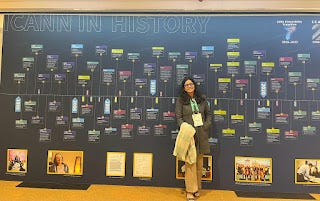
ICANN78: A Fellow Journey!

My journey as an ICANN fellow began just a few months back when I received that all-important email from our fellowship program manager, letting me know that I had been selected. But, here’s the twist – I didn’t actually check that email until the following day. I guess I was caught up in the busyness of life and didn’t realize what a significant moment it was.

Yes, before proceeding further, for those who don’t know what ICANN is?  Internet Corporation for Assigned Names and Numbers (ICANN) is a non-profit, American-based organization that operates as a multi-stakeholder group. It is tasked with overseeing the management and protocols governing various databases associated with the naming and numbering systems on the Internet. Its primary mission is to guarantee the stable and secure functioning of the global network.

Returning to my account of this journey, once I had confirmed my participation, our fellowship manager quickly became my primary point of contact. This was particularly valuable for newcomers like me. They played a vital role in helping us navigate the intricacies of the ICANN Fellowship program, serving as a friendly and knowledgeable guide to steer us through this thrilling opportunity.

But that wasn’t the end of the adventure. Getting a Schengen visa, which allows you to travel within certain European countries, turned out to be a journey in itself. It involved a whirlwind of activities – gathering documents, going through verifications, handling passports, and taking care of all those visa-related requirements. 

And let me tell you, it was no walk in the park. My first attempt at getting the visa didn’t go as planned. It was rejected, and the reason they gave was a bit perplexing – they said the “source of sustenance” was missing. I couldn’t help but wonder why the German government had turned down my application. After all, I was just going to be in their country for the duration of the fellowship, and I had everything I needed to support myself during that time.

So, my journey as an ICANN fellow has had its fair share of unexpected twists and turns. It’s been a lesson in patience, perseverance, and the importance of having a supportive fellowship manager to guide the way. And as I embark on this incredible opportunity, I can’t help but look forward to the adventures and discoveries that lie ahead. Who knows what other surprises were in store??

As a strong believer in God, I experienced a week filled with ups and downs. It was a week of rejection and acceptance and a pivotal moment that led me to discover an incredible opportunity. I had just been rejected, but in the same week, I was introduced to my mentor for a prestigious fellowship. Our very first Zoom meeting took place on that same day, and I decided to share my concerns with my mentor. To my amazement, he not only provided me with a solution but also offered guidance on how to ensure a successful second attempt. Miraculously, my visa application was approved.

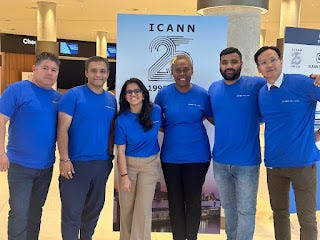
Our mentor had a profound message for us: “ICANN is an ocean of opportunities. Your journey may not be easy, but the challenges you face will ultimately lead you to fruitful destinations.” This resonated deeply with me. Alongside seven fellow mentees, I embarked on a journey into the world of ICANN (Internet Corporation for Assigned Names and Numbers) and found myself in the At-Large Advisory Committee (ALAC). Our mentor continued to guide us throughout this incredible journey.

During our mentorship, we had the privilege of e-meeting individuals who had dedicated a significant portion of their lives to ICANN, with 10 or even 20+ years of experience. It was an inspiring experience that emphasized the depth and vastness of the ICANN community. As October arrived, we entered into the month of our fellowship. The first week was dedicated to “Prep-week,” where we were introduced to various community stakeholders in face-to-face e-meetings. These meetings provided us with a comprehensive overview of the different communities and their functions within ICANN. Living in India, I faced the challenge of dealing with a significant time difference. After long days at the office, I would rush back home, grab a quick meal, and then dive into the prep-week activities. It required not only physical presence but also a sharp and focused mind. This was an opportunity that I could not afford to take for granted.

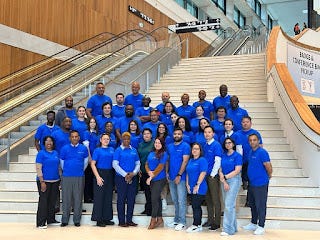
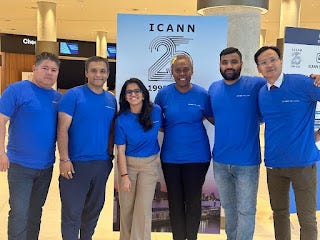
The last day of our prep-week was a remarkable one, as all the fellows, accompanied by our fellowship manager, had the opportunity to connect with a multitude of individuals representing diverse corners of the globe. It was a truly enlightening experience that greatly broadened our comprehension of the global ICANN community.

Then came the long-awaited D-day, October 21, 2023, at Hamburg’s CCH. We were all dressed up and heading to the venue for our very first day of the event. The initial two days were nothing short of overwhelming. We found ourselves amidst a sea of acronyms, and quite honestly, even now, it can be a bit bewildering, to make choices about which sessions to attend. Sometimes it feels like trying to remember all those acronyms would put our neurons under too much stress.

However, the turning point arrived on day three. It was a day of warm welcome by the Government of Germany. The experience was simply enchanting as we walked into a hall filled with vibrant colors and the smiles of attendees, both new and seasoned, with eyes filled with the sparkle of dreams. It was a momentous experience that will be cherished for a lifetime. Over the next two days, we engaged in sessions, interactive parties, DNS Woman gatherings, and much more. One of the most exceptional aspects of ICANN is the incredible networking opportunities it offers. No matter how introverted a person may be, spending time here for these six days will likely turn them into an extrovert. It’s not so much about you stepping out of your introverted shell; it’s the supportive and inclusive environment at ICANN that makes you feel so comfortable that engaging with people becomes a delightful experience, rather than something to be hesitant about.

You build friendships, find constant companionship, and gain knowledge. ICANN embraces the ethos of working diligently and celebrating heartily. I encountered a multitude of individuals during my time there, too numerous to mention here in one blog post. However, one principle remains paramount: trust the process of networking, immerse yourself in social interactions, and embrace the learning opportunities. As my journey within ICANN unfolds, I am brimming with excitement to discover where this path will ultimately take me. The trials and prospects on the horizon serve as a testament to the adage that what initially appears to be a challenging journey often leads to the most gratifying destinations.

For those individuals who are considering becoming a part of ICANN, you can explore the following URL: https://www.icann.org/fellowshipprogram. This website provides a concise and informative overview of the fellowship. As for others, you are welcome to reach out to me through this LinkedIn link: https://www.linkedin.com/in/barkha-manral/

Never think that you are done with fellowship now it is the end, No instead it is the beginning because ‘ONCE A FELLOW,  ALWAYS A FELLOW’.