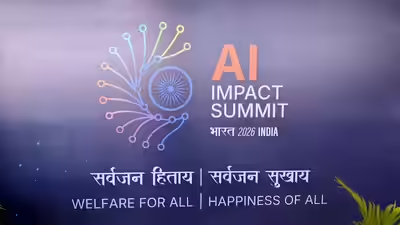
Last week, attended the India AI Impact Summit 2026 in New Delhi. The Summit brought together policymakers, industry leaders, startups, researchers, civil society members, and international delegates from over 88 countries to discuss the present and future of artificial intelligence on a global stage. For someone invested in Internet governance, digital public policy, equitable access, and multistakeholder governance, being there was both exhilarating and sobering.
1. Scale and Public Engagement were massive
From the moment you entered the summit expo and conference spaces, the energy was unmistakable. The exhibition halls were packed with people exploring AI innovations, from tool demos and startup showcases to products meant to scale AI applications across sectors. Government ministries, global tech firms, and academic institutions all had a presence. It was clear that both domestic and international participants took the Summit seriously. Official figures indicate that the event saw more than 5 lakh visitors, and the government highlighted that this reflected strong local engagement alongside global participation. However, sheer size also had its impacts. At times, the crowds made meaningful participation in discussions difficult, long queues, packed pavilions, and tight walking routes meant that many sessions felt more like networking marathons than deep policy conversations.
2. A Summit Focused on Economic Narratives, With Governance in the Margins.
One of the most striking patterns of the week was how often economic narratives and investment optics dominated the discourse:
- Organisers highlighted that infrastructure-related investment commitments crossed USD 250 billion, alongside deep tech and venture capital pledges.
- Governments and corporations emphasised trade, innovation partnerships, AI industrial ecosystems, and scaling of AI products.
While economic significance is not inherently at odds with good governance, the emphasis on market outcomes often overshadows conversations about norms, rights, accountability, and structural governance design, areas central to Internet governance work.
3. The New Delhi Declaration: Aspirational, Voluntary, and Soft on Enforcement
A major official outcome was the New Delhi Declaration on AI Impact, endorsed by 88 countries and international organisations — a record number for this summit series. The Declaration stresses themes like:
- Democratising AI resources and expanding access.
- Human capital development and workforce readiness.
- AI for economic and social good.
- Democratically guided, inclusive AI ecosystems.
It also proposes voluntary platforms and frameworks , such as a Charter for Democratic Diffusion of AI, Global AI Impact Commons, and Trusted AI Commons, designed to encourage collaboration. But, as many Internet governance practitioners have noted, the commitments in the Declaration are non-binding and cooperative rather than regulatory. This creates a tension between the vision of equitable, shared AI governance and the reality of soft, principle-based outcomes.
From an Internet governance perspective, meaningful influence on global AI norms requires mechanisms for accountability, interoperability standards, and enforceable frameworks, not just broad principles. With voluntary commitments, there’s little to ensure that priorities such as fairness, privacy, and rights protection are implemented consistently, especially in less-regulated environments.
4. Sovereignty, Inclusion, and the Global South Narrative
One of the historic aspects of the Summit was its hosting in the Global South, marking a symbolic shift in the geography of global AI dialogues. This brought air to discussions of sovereignty, the idea that nations should have autonomy in shaping how AI technologies impact their societies, and inclusion, meaning that AI should serve a broad cross-section of populations, languages, and contexts.
Yet there were underlying tensions:
- Balancing sovereignty with global cooperation isn’t straightforward, especially when AI governance standards are emerging mostly from a few powerful tech hubs.
- The Summit’s framing of inclusion often emphasised access and scale rather than rights and redress mechanisms.
Good governance frameworks are not just about scale or access, they’re about who gets to shape the rules, who is heard in decision-making processes, and how power imbalances are addressed. These remained under-articulated in the official narrative.

India AI Impact Summit 2026
5. My Takeaways, What This Means for Internet Governance Work.
Being there made three things especially clear:
1. Attention is shifting, but governance must catch up.
Global interest in AI is undeniable. Investment, collaboration, and innovation narratives will continue to grow. But if governance does not keep pace, we risk letting technological markets drive policy agendas rather than policy priorities shaping technological futures.
2. Non-binding commitments only go so far.
From an Internet governance standpoint, we need frameworks that move beyond aspirational principles to accountability mechanisms, standards, and enforceable norms. Voluntary multistakeholder agreements are only the first step.
3. The Global South and Majority World must lead the conversation, not follow it.
Hosting the Summit here signals a shift in geography, but influence comes from how governance architectures are shaped, who is seated at the table, and whose priorities become operationalised. This is the conversation that must broaden and deepen beyond one week of headlines. The India AI Impact Summit was a remarkable gathering of historic significance, marking a chapter in addressing people’s concerns about emerging technologies.
The challenge now, for India, for Internet governance communities, and for global digital policy practitioners, is to translate momentum into meaningful governance outcomes that ensure AI serves people, rights, societies, and democratic values.